Dear Beekeeper,
i’m incredibly possessive over my home space, and i have been ever since i can remember. i’m currently working through that in therapy (EMDR, all that jazz) and discerning that it started when i was young & was reinforced many times over the years. all that’s to say, being territorial around my home feels like an innate part of me, at the core of how i exist in the world. as an introvert, this has been incredibly helpful over the years -- knowing i have a space to retreat from society & self-soothe, rest, etc.
now that’s not to say that i don’t let anybody in my house haha. i have family and friends come and stay overnight, friends have gathered in my living room for craft afternoons, & i love hosting backyard cookouts and potlucks. but in general, i’m pretty intentional in who i invite into that space, and what access they have (i know, i know, i’m also currently working through my relationship with power & control with my wonderful therapist)
when asked in an ice-breaker game years ago, “what would you change about yourself, if you could?” i answered that i wished i was more hospitable and open to hosting people at my house. the more i thought about it, the more i remembered how often hospitality is talked about in scripture. as a public-facing christian leader, this seems like something i should be better at, right!?
and yet, as a public-facing person, with a public online presence, i adore having a place just for me and the handful of folks i invite in. i like that i’m hard to access when i’m at home. i enjoy having decorations in nooks & crannies that nobody but me & my cat may ever see
ultimately, i feel like i *should* be more hospitable. but i already share so much of myself with others -- is it wrong to be a bit of a dragon in a den, all curled up & cozy?
—Dragon in Her Den
Dear Dragon,
First, let’s acknowledge that you are holding some high standards for yourself. I hear in your letter the pressure to be fully, fully known; and perhaps witnessed as one who is as she “should” be in hospitality. It IS totally all throughout the scriptures!
However, the people writing, and most of the audiences reading (until only the last 30 years or so) didn’t have internet. The public presentation of self was a mostly contained offering. And those hospitality texts we love to cite, Romans 12:13, Hebrews 13, 1 Peter 4, were written to communities under pressure, displacement, exile. The instruction to welcome strangers was issued to people who were themselves strangers. That is a different situation than you all cozied up with your cat.
Further, Jesus and his inner circle were nomadic, wandering with the Good News, and found “home” through the hospitality of strangers. Of course hospitality is everywhere in scripture. It was survival literature for people without a fixed address. It makes sense to me that the value runs so deep, especially when we collectively imagine a world where all have access to the choice of home.
And notice: the primary unit of hospitality in those texts is not the house, it’s the table. The bread. The oil. The shared meal. Many do that work through their public professions, and how they show up in community in mutual aid. You are already doing that every time you gather people in the church you serve, the communion you offer, and every time you host a potluck in your backyard.
Of course you’re not wrong to be protective of your home space.
Have you seen the inside of a honeybee hive? It’s predictable, and perfect for the bees. They create it to be what it needs to be for the overall function of the hive. Young bees make wax through special glands on their abdomens. They shape that wax by chewing it up, and then shaping it into perfect hexagonal shapes. It’s precise; exactly as it needs to be. There’s some choice about hive production there: slightly larger cells produce drones (male bees), and specially shaped cells dangle with extra room for the Queen.
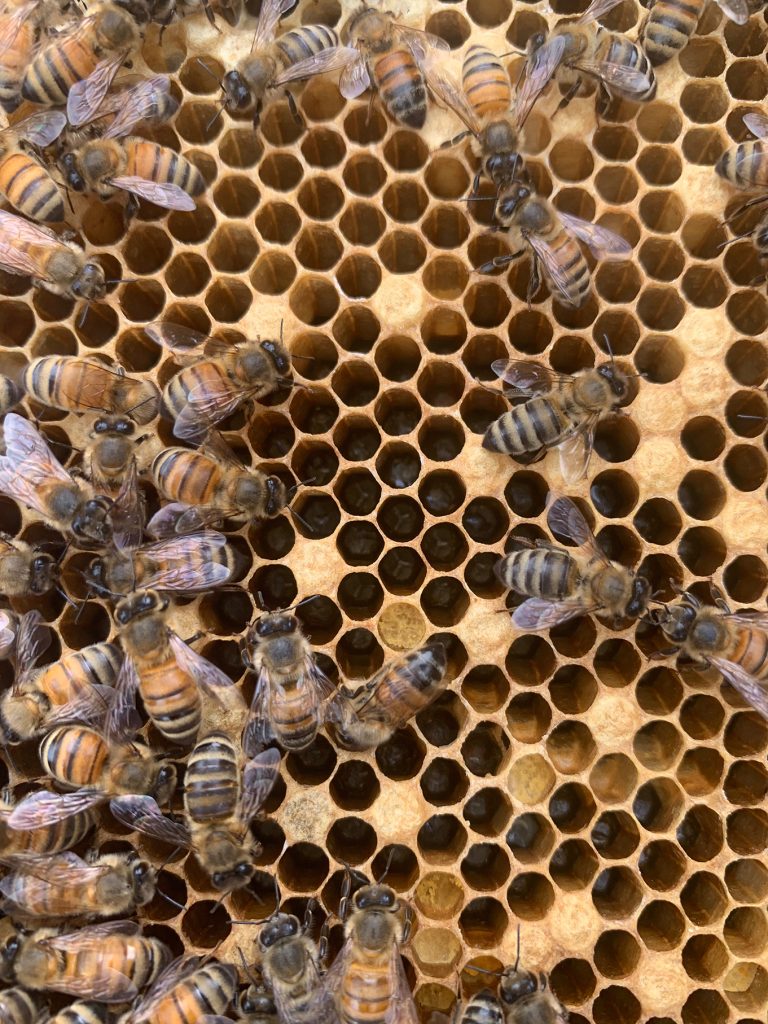
A honeycomb cell functions for multiple purposes and can shift. Eggs laid within them become larvae, then emerge as honeybees. Or they fill it with honey and cap it. The cells themselves are boundaries and borders to the function of the hive. They contain everything necessary for the bees, and the integrity of each hexagonal chamber is what makes the whole structure possible.
I think about their protectiveness of their hive. Any perceived threat is going to feel it, physically, through their sting, and bees stand guard at the entrance for intruders to protect their honey horde, their young, their queen. However, when I meet the honeybees out foraging, they are so gentle. When they are on the flowers in my garden, the hospitality of pollination is so abundant! They offer tiny messages of hope and reproduction from flower to flower.
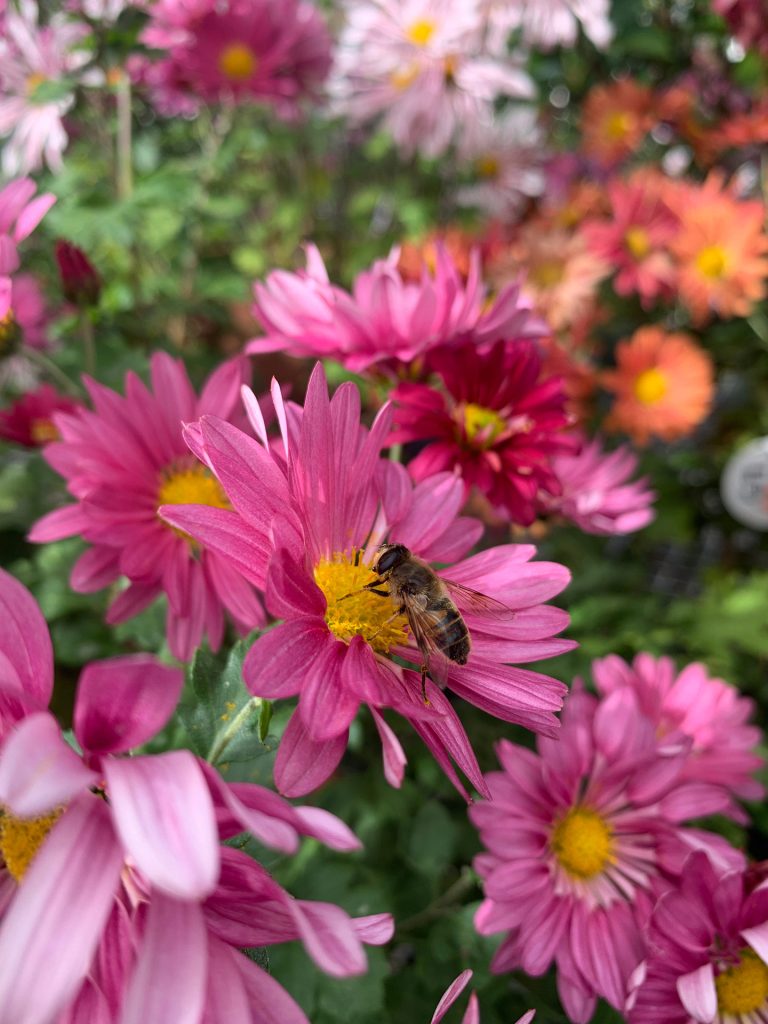
They aren’t able to pollinate if there’s no hive to bring the pollen back to. Their protected hive is the foundation of their hospitality to the bloom.
Dragon, there are many ways to be hospitable, and your assessment of your own is only applying one lens, through the most intimate part of your inner castle. It’s not a binary, sweetheart; where either you’re entirely hospitable or nothing counts at all. It’s a spectrum of care where your public facing self is hosting a hospitality of hope for all whom you encounter. It’s certainly not a control issue to want your home as you like it.
The boundaries made of your home space: the wax cells each holding a treasure telling a story for your own eyes only… this isn’t a failure of abundance, but an architecture of sustainability for the very public facing work you do with your brain, your proclamation, your internet self.
As ministry carries on, it is even more important to have places where you can let yourself just bee. Bee messy… bee hyper attentive to your space… bee cozy…
And bee hospitable to the tiny cat with whom you’ve chosen to share your home.
It’s impossible to be ALL on, ALL the time, and restoration and retreat enables you to sip from the sweet cozy honey of your den to emerge ready to pollinate all that might bloom in communities.
The last thing I’ll offer is through the lens of the Ordained Ministers’ Code of the United Church of Christ. While specific to the UCC, I do think it’s applicable in wider ways. Amongst commitments to church, community, ethical behavior, growth, and family, is the following line:
I will honor my need for time for physical and spiritual renewal, recreation, and vacation.
Dragon-in-Her-Den, your home is your spiritual renewal. Cherish it.
P.S. Dear Reader— yes you! Are you holding something close for which you might need a little honey? Then write in and and join alongside this ever-growing hive of hope and care! 🐝